Pages

Showing posts with label Cooking. Show all posts

Thursday, 27 August 2015

Where are my savings going? Looking at fossil fuel divesting.

Hard to see that we are surrounded by mountains with all this smoke.


It's been a few weeks since I have posted anything. Shortly after my last post I drove down to Washington State to visit friends and do some research - my fourth and last trip of the summer. Even then - mid-August - smoke from forest and grass fires was heavy in the air.

On August 13th, when we were driving to Omak, smoke from a fresh fire rose like a huge mushroom cloud in the air. When I left on the 15th, I wasn't even sure that the roads north would be open.

When I arrived home to Revelstoke we had some refreshing rain followed by cooler weather and a few days of good sunshine. I was able to take advantage of those sunny days to bake a banana cake and a loaf of bread in my solar cooker. The cake recipe said to bake the batter for two hours but I took the cake out after 1 1/2 hours and felt it was overcooked. I think one hour of baking in the mid-day sun would have been perfect. The bread wasn't perfect because, as the sun moved, the cooker became shaded and the bread flopped. It's edible though. Next time I'll start baking around noon.
The bread wasn't perfect because I wasn't there to protect it
from the shade but I can see how it would work.

Part of the challenge of baking bread with only sunlight is heating water early enough in the day to permit the bread dough to rise twice for at least an hour each time. I discovered that my SunRocket solar kettle, which I had not used much up until now, was the perfect tool for heating water quickly. With only ten minutes in the morning sun, I had warm water that could be added to the yeast.

By Sunday and Monday the smoke from the forest fires drifted into the Revelstoke valley. The mountains, if they could be seen at all, were just a dim outline and I could feel the smoke in my lungs.

This intense fire season makes me think often of global warming and the reasons that I'm doing this project. It also highlights another limitation of solar energy. Like clouds, smoke obscures the sun, making cooking almost impossible and greatly reducing the energy output of the solar panel.

*  *  *

One of my concerns in recent years has been saving for my retirement. I have struggled with the idea of mutual funds because I know that my money would be supporting companies with practices that I have serious concerns about. Most mutual funds, even ethical funds, invest in energy - i.e. oil and natural gas - and mining. While I benefit from the products of these industries, I am also very aware of the damage that they can cause. 

I have been investing my retirement savings in ethical funds but with this project I would like to go one step further and invest in funds that have divested from fossil fuels. Is it possible to do this while working with the financial institutions available in Revelstoke? 

I went around to all the banks, the Credit Union and investment companies. I learned that the banks had access to ethical funds but they did not have mutual funds that had divested from fossil fuels. Richard, at the Royal Bank, was very helpful. He said that if I did the research on fossil fuel divested funds, most banks would be able to set me up with a broker who could facilitate the purchase of that fund but that is the most they can do.

I also visited Investor's Group, which has its own socially responsible fund but no fund that has divested from fossil fuels. They offered to help me invest in particular companies but I am really looking for a more balanced mutual fund that is divested from fossil fuels.

My appointment with the Edward Jones representative is not until September so stay tuned.

Through my research, I learned that VanCity Credit Union has developed a fund that is divested from fossil fuels. The fund is called IA Clarington Inhance Global Equity SRI Class and it can be bought through our local Credit Union. The disadvantage with this fund is that it is an equity fund so it has more risk. We've been reminded of the risks in the dramatic events in the financial sector this week.

I think that if people keep asking their financial institutions for fossil-fuel-free investment options those institutions will eventually respond, just as VanCity did. 

I'm receiving e-mails from several campaigns that promote fossil fuel divestment. One interesting one is the Guardian newspaper's Keep it in the ground campaign. Another interesting group is 350.org. These campaigns try to persuade big investors to divest: Bill Gates, universities and pension funds. They don't seem to have much for small investors like me. Globe.net also has an excellent newsletter that deals with climate change issues from a business perspective.

Post Script, September 3

This week I was able to meet with Chris Bostock at Edward Jones in Revelstoke. Edward Jones does have access to a fossil fuel free mutual fund but Chris also talked with me about creating a guided portfolio where the client chooses the companies s(he) invests in. It is still done in a balanced way and guided by the Edward Jones representative. This option was also offered by the banks and Investor's group using their external brokers.

The positive side of this is that I don't have to include companies that I have concerns about and I can support companies that I believe in. The negative sides are that I am not as knowledgeable about investing as a professional would be and the minimum investment is a lot more than many people can afford - a $50,000 minimum. 


Wednesday, 29 July 2015

Food woes and my mighty, home-made rocket stove

My rocket stove, made out of five tin cans, used a minute amount of fuel to cook my dinner.
Adversity is the best impetus for experimentation. A summer of continuous sunshine would have made my off-the-grid summer very easy. So I guess it was a good thing that we've had a couple of weeks of cloudy weather and a fair amount of rain.

Since at least July 11th, after a very long heat spell, we've had primarily overcast days. For me, that means I have to be doubly careful with my electricity use because I don't know when I'll get a good charge in my batteries again. It also makes cooking - and entertaining - very complicated.

Most of the time I have been eating raw food or cooked food that is cold or luke-warm. Unless I plan to have a raw-food dinner I can't invite friends over because I can't count on enough sun to cook for them. A solar cooker is, after all, a slow cooker and requires hours of sun to properly cook food.

If I did manage to cook something, I would cook enough to have leftovers which I would just reheat - which takes less time. Still, putting meat out for two hours in half-hearted sunshine left me with worries of food poisoning - another reason I wouldn't share with friends.

Photo: Agathe Bernard
On the morning of July 18th I was scheduled to give a solar cooking demonstration for our NCES Sustainable Living Committee outside Big Mountain Kitchen. Luckily we had beautiful sunshine for the event and I was able to cook a sizzling sausage stew, accompanied by raspberry smoothies and home-made pesto on spiralized zucchini.

But then the clouds returned, just as I was wrapping up my demonstration.

Sausage stew before cooking at solar cooking demonstration.
Photo: Agathe Bernard
After so many cloudy days, I was beginning to feel a bit sorry for myself and was madly looking for options. On rainy, cloudy days it's nice to enjoy a hot dish or a hot cup of tea.

My family and friends have been wonderful. They continue to invite me over for hot meals. Applying the potluck rule, I bring a dish - often a Greek or tomato salad as the tomatoes and cucumbers in my garden are plentiful.


I began to experiment with quick-cook options. I was able to make an almost-cooked quinoa dish in two hours of sunshine one morning. I topped that with some tinned mussles, feta cheese and tomato for dinner and it was delicious.

The next day we had an hour and a half of sunshine around noon. I whipped up some eggs with onions from the garden, cheese, peppers and herbs and had a delicious and fully-cooked omelet.

In the meantime I researched every alternative to cooking with solar or fossil fuels (see below) that I could find.

I found the website instructables.com to be very helpful. There were several items that explained how to produce biogas that can fuel a small stove using compost and cow manure (I would use horse manure as that is more readily available). The process takes about 10 days but I would happily eat cold, raw food if I could accomplish that!

The downside is that it doesn't seem to produce much gas and it seems to be better suited to warmer climates. If it were warm here, I'd be using solar. Unless I become very desperate it doesn't seem to be practical for my project.

I also researched other ways of generating electricity such as using a biolite campstove to trickle-charge my phone or building a bicycle- or wind-powered electrical generator. The latter two would help me charge my appliances but they wouldn't help my cooking situation. The biolite requires small amounts of wood (see below) and I need more electricity than it would likely provide.

My cousin, Heather, has been researching fuel-efficient cooking technologies. She mentioned the rocket stove, which uses very little fuel. I like the idea of experimenting with low-fuel cooking techniques, although it meant adjusting my rules a little to allow fire for cooking.

I found instructions for a rocket stove made out of five tin cans on instructables.com. I was able to get an empty big can from the deli section of Cooper's Foods. I raided my neighbour's recycling bag for the other four cans. The latter cans were slightly bigger than those mentioned on instructables, but it was what I had and it worked.

But there was a problem. After a long heat spell the fire hazard rating in much of southern BC is high. In our area, the Southeast region, there is currently a ban on open fires and campfires. I was sure that my rocket stove was safe, especially after so much rain, but would it be permitted? I have a nice stone patio close to a hose bib so I had a good, safe set-up but I also didn't want to break the rules with a public project.

I phoned the fire department to find out if I could use the stove and the answer was no. According to the assistant fire chief, "The prohibition does not apply to cooking stoves that use gas, propane briquettes, or to a portable campfire apparatus with a CSA or ULC rating that uses briquettes, liquid gaseous fuel, so long as the height of the flame is less than 15 centimeters. The use of any apparatus that does not meet these specifications is prohibited."

This means people have no legal options to fossil fuels except briquettes; home-made stoves seem to be out of the question. In my mind, this discourages experimentation and innovation, something we need right now as we try to adapt to climate change.

I'm not inclined to use charcoal briquettes as they are much more process and polluting than what I am proposing. However, the thought of manufacturing briquettes out of waste material is appealing. I might pursue that.

Anyway, after I told my friend Maria-Lynn, that the fire department vetoed my stove, she said she had recently come back from volunteering with a 'Learn to Camp' program with Parks Canada at Mount Revelstoke National Park, right next to our town. She mentioned that the fire hazard rating in the park is low.

It is just a short hike up Mount Revelstoke to the national park and I could just taste the sausages I would soon be cooking.

I phoned Parks Canada and even brought my stove to their reception. The response was
enthusiastic and soon I headed back home with my stove in hand and official confirmation that I could use it at a fire pit in the park.

My dad and I up Mount Revelstoke, probably in the early 1980s.
I packed dinner for three and invited my friends Maria Lynn and Marc to join me for a meal up at the Monashee cabin and lookout. The stove, which is insulated by sand, weighs just over six pounds so the pack, with food and stove, was fairly heavy.

It was an hour-long walk up the mountain to the cabin, up a beautiful trail, past where we scattered my father's ashes only two months ago. Dad and I had walked that trail together so many times that it felt like he was joining me on my adventure.

Unfortunately I had forgotten that the road up Mount Revelstoke closes at 4:30. My friends never managed to join me, despite their valiant efforts. Still, I got to try out my rocket stove and that, and the beautiful view was well worth the hike. Ironically, this was one of the few sunny evenings and I could have cooked at home with my solar cooker.


The rocket stove was really interesting. It uses very little fuel. To say that I used kindling as fuel would exaggerate the size of the wood. I brought up two tiny scraps of wood and some newspaper. I was able to gather some twig-sized pieces of wood at the cabin. I found that if I pushed more than two small pieces of wood into the stove the fire would go out. With this first effort, it did not burn as hot as I hoped but it cooked my sausages and bacon with very little fuel. (Here I am showing a before and after shot of the fuel consumed).


My rocket stove before I lit it.


As I walked down the mountainside the moon was out and the view was spectacular. Despite the hike and relatively heavy load for a simple dinner, I felt that my experiment was well worth it.

I don't think my rocket stove constitutes an 'open fire.' When the pot is on it there is no flame to be seen. I hope that some day soon I'll be able to use it in my back yard.

The moon was shining on my way down and the view of Mount Begbie was spectacular!

Wednesday, 8 July 2015

Camping with the sun

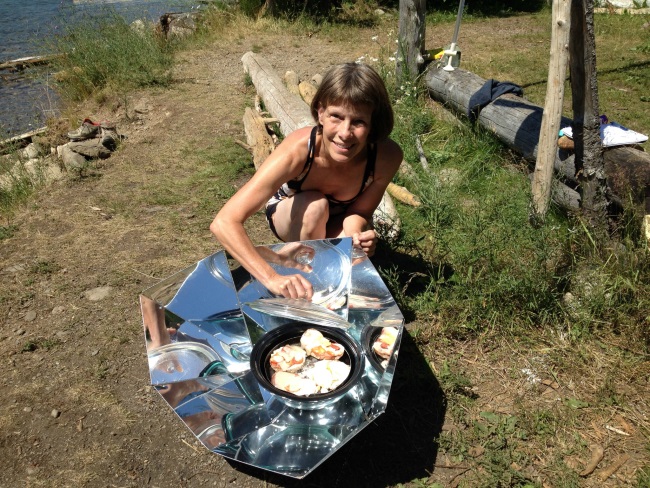
Showing off a cheese melt with salami, home-grown tomatoes and cheese melted on top.
Photo: Tuulikki Tennant

Last weekend my friends Cindy and Tuulikki went camping north of Revelstoke. We had been planning this trip for more than a year but something always came up. I couldn't let my summer project make us postpone it again. That was one motivation for having a budget of two car rides (return) a month.

Even though we took Cindy's vehicle, this still counted as one ride. Carpooling is always better than driving alone but it still consumes fossil fuels.

View from campsite.
We had a wonderful, private campsite by the lake and within view of a stunning glacier and the iconic Frenchman's Cap peak.

Unfortunately, there is a campfire ban in place due to the extremely dry conditions. Though I couldn't have cooked over a fire, a campfire is always a treat.

As it turned out, all the meals I enjoyed were fossil-fuel free - except one coffee, which I rationalized using the pot luck rule. Cindy prepared a lovely first dinner with Greek salad and locally-made, cold sausages.

I made us cheese melts for lunch - local bread topped with salami and tomatoes from my garden with melted cheese on top. We found that putting a dark metal dish in my solar oven bowl worked well for making several sandwiches at once. They took about 20 minutes to cook and then we topped them with fresh slices of cucumber from my garden.

Raspberry smoothie.

Smoothies made from raspberries from my garden, yogurt, milk and a dash of maple syrup were a special treat. I mixed it in a nifty hand blender/food processor that I'm finding to be very useful.


The spiralizer turns any hard vegetable into spaghetti-like strands. The vegetables can be tossed with any sauce.
For dinner I made a sausage stew with almost all local ingredients: chopped onions and sausage from the farmer's market, and tomatoes and herbs from my garden from my garden. I think there was a pepper from the store. I let it all cook for about 4 hours in the solar cooker until the flavour was nice and rich. I did worry during the last hour when we had a bit of cloud cover but it was well cooked by the time we ate it.

Sausage stew and zucchini with pesto.
I served it with a spiralized zucchini dish, smothered in home-made pesto and chunks of walnuts from Cindy's tree.


For breakfast, Tuulikki prepared muesli for me. The night before she mixed oats, vanilla yogurt and dried fruit and nuts. By the next morning it was a delicious oatmeal treat.

I had my infused coffee both mornings, though I must confess that I accepted one hot coffee, cooked on the propane stove, on Sunday. Thank heavens for my potluck rule.


*  *  *

On Sunday we headed up to the Keystone Valley which is always spectacular. The meadows are full of wildflowers: rhododendrons, paint brushes, asters, arnica and anenome are visible well before their usual grand display. They will be at their peak in about two weeks.

The first time I hiked in this region the flowers were at their peak the first weekend of September.

With the haze in the air from forest fires and the unseasonably early wildflowers we talk about climate change as we hike those beautiful trails.


Tuulikki and I are well covered because the horse flies and mosquitoes were
plentiful.
Photo: Cindy Pearce